

It was a quintessentially wet London morning when I pulled up to King’s Cross’ Story Gardens in early July. Decolonising Economics were leading a day-long festival highlighting Black and POC-led solidarity economics organising in the UK, both past and present, and I’d signed up to volunteer.
My jobs were to check tickets, hand out programs, and answer questions – easy enough.
But the winds had picked up and mingled with the rain in that way that leaves your fingers and toes numbly cold. Handouts and zines flew from their piles and settled in puddles. Umbrellas turned inside out, rendered useless. Oh, Babylon. As I stood huddled and shivering under a thin tarp canopy willing more attendees to arrive, I worried the day was over before it had even begun.
Would the Black Feminist Bookshop still be able to set up their full offering of books for sale? Would we hear Claude Hendrickson talk about housing and governance over the downpour? Would the barbecue reach sufficient levels of heat and smokiness for the vats of seasoned chicken, ready and waiting to be cooked??
Founded by Guppi Bola and Nonhlanhla Makuyana in 2019, Decolonising Economics has been at the forefront of challenging traditional economic paradigms and promoting alternative models that prioritise community, sustainability, and social justice.
Over the past five years, the organisation has grown from a small grassroots initiative to an influential force in the UK’s solidarity economy landscape, with its network expanding and directly impacting numerous community-led projects across the country.
And on this day at Story Gardens, the Solidarity Showcase was set to mark a significant milestone in the growing movement to reimagine and restructure economic systems through a decolonial lens.
In true liberatory fashion, the threat of rain made way for an abundance of sun. My volunteer hours flew by as I worked alongside Debs Durojaiye, a designer and community technologist who would lead a workshop on Movement Infrastructure later in the day. I met organiser and body worker Sophie Yates-Lu, who I’d been liaising with in her role as a Volunteer Coordinator and, weeks later, would give me an amazing massage as part of her healing practice centring Black and POC bodies.
The food was fantastic, the garden’s lavender fragrant, and the abundance of knowledge shared was life-giving water for our collective dreaming and working towards just futures. To cap off the day, Amina Mumbi and her live band led us in a joyous singalong of Luther Vandross’ Never Too Much, adlibs and all. What a gift the day was.

Below is an overview of four of the workshops and talks I attended, exploring themes of resistance organising, collective resourcing, community ownership, and self-governance.
Community Ownership and Self-Governance
Moderated by Guppi, the panel discussion centred around the provocation: If we are not prepared to govern, are we prepared to win? Angelique Retief, a PhD candidate at Bristol University, Kwame Lowe of Kin Structures, and Claude Hendrickson, founder of Frontline Self-Build, shared their experiences and insights on collective organising towards governance and ownership models that align with Solidarity Economy principles.
Angelique discussed her research on indigenous approaches to development, specifically focusing on housing in townships in Cape Town, South Africa. Her work aims to operationalise the philosophical approach of Ubuntu in creating more sustainable housing solutions. Angelique also shared her experience with the Black South West Network in Bristol, which successfully bid on two plots of land through Bristol City Council’s Land Disposal Scheme.
“By applying Ubuntu principles to housing development, we’re not just building homes, but fostering communities,” Angelique explained. “This approach challenges the individualistic model of property ownership dominant in the West.”

Kwame spoke about Kin Structure’s mission to create a permanent home for grassroots culture in London, “as people who were involved in cultural work, as artists, we were struggling to find spaces that actually treated us in a way that could sustain our creativity in our city.”
He highlighted the importance of community centres as dormant infrastructure that could be revitalised to support local communities, spaces that could intentionally support culture in a multiplicity of ways.
“We’re currently located at Soanes Centre in Mile End’s Centenary Park. It supports local primary school children to access nature and ecology, and almost single handedly shares the park with over 7000 local school children every year, most of whom are Black or brown. And it’s an amazing resource. We’re trying to think about how it can be sustained. And we’re seeing it as a demonstration of what our vision for community centres could be.”
Claude Hendrickson shared his 30-year experience in advocating for community-led housing and Community Land Trusts. He stressed the importance of involving Black and ethnic minority communities in solving housing issues, especially considering the systemic barriers that often prevent marginalised communities from accessing land and resources.
“This housing crisis has been rolling on since the 60s. This housing crisis is not a problem of migration. It’s a problem of Britain not building enough houses, they’ve just not been doing it. Social housing should be an infrastructure component.”
The importance of stewardship as an ownership model was also a discussion focus. Claude spoke of the importance of 999 year leases, adding “that’s eight, nine generations of our people. Sometimes, especially in London, land is expensive or there’re so many hurdles you have to go through. A 999 year lease gives time and options.”
Imagination and Experimentation in Movement Building
Featuring author Kimberly McIntosh and climate activist Mikaela Loach, this plenary session highlighted the importance of continuing to show up and do the work, even in the face of challenges.
Kimberly shared her perspective on balancing activism with self-care, acknowledging the need for rest to sustain long-term engagement. “We often glorify burnout in activist spaces,” she noted. “But taking care of ourselves is a revolutionary act in a system that doesn’t value our wellbeing.”
Mikaela discussed her journey from a place of survivor’s guilt to finding joy and gratitude in continuing the work of her ancestors. She also addressed the challenges of maintaining hope in the face of slow progress. “Sometimes it feels like we’re not moving fast enough,” Mikaela admitted. “But when we look back at history, we see that change has always come from sustained, collective effort.”
From the audience, Noni also touched on the importance of imagining and practising alternative ways of being, even in small moments. They referenced the play Anatomy of a Black Rebellion by Zahra Dalilah, which depicts the organising that happened during the Haiti slave revolt, highlighting the continuity of resistance and imagination across generations.
Radical Rest and Unprofessionalism

Evie Muir’s book reading from her debut collection of essays, Radical Rest, at the Black Feminist Bookshop provided insights into her journey in organising.
Muir shared an experience of embracing anger and finding community support during a Decolonising Economics retreat, recounted the liberating moment of sending an unapologetic email in response to funding cuts. It was dubbed the “email of all emails” by retreat participants.
Muir’s reading not only highlighted the transformative power of collective rage, but also the importance of rejecting the pressure to be palatable in the face of injustice. She emphasised how unprofessionalism can be a tool for reclaiming power and expressing the impact of systemic harms.
“In a world that demands we shrink ourselves to fit into professional moulds, being ‘unprofessional’ can be a radical act of self-preservation,” Muir argued. However, she also acknowledged the potential consequences of this approach, particularly for marginalised individuals who may face harsher repercussions for challenging norms.
Building Libratory Movement Infrastructures
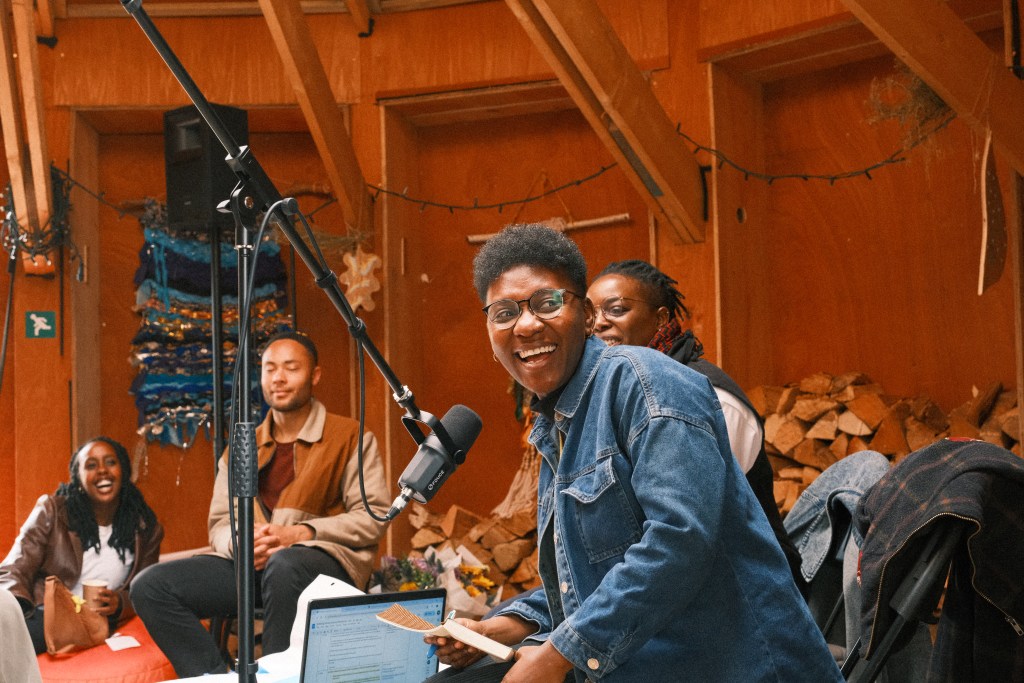
Led by Mumbi Nkonde and Debs Durojaiye, this workshop explored the concept of infrastructure in social movements, encompassing both tangible and intangible elements such as healing and care work, financial and legal mechanisms, and communication tools.
“Movement infrastructure is the fluid container – the things and the stuff and the how – that allows us to get from our ideas into mobilisation and implementation,” Mumbi summarised. They also spoke of the many of the underlying services and systems, like the unpaid labour of care work in all its forms, that sustain our lives but go completely unrecognised or undervalued. “This is the work that’s really intimate, that’s very gendered, racialised, and classed.”
Mumbi noted that while many groups prioritise one model of infrastructure, non-hierarchical consensus-building, the Black Radical Tradition gives examples of many more. “There are other modes of operating that recognise the benefits of having leadership, accountable leadership, that’s not rooted in hoarding power but in understanding how you spread out and share power.”
Debs recalled speaking with the Pan-African Workers Association, a self-organised group of care workers from strategically-underdeveloped countries who are being exploited in the UK.
“They’re about to start using the model of paying little bits of money into a pot because most of them are being brought over here and then don’t actually get given any work. [Our discussion] was beautiful and powerful, and it reminded me how important this is for all of us.”
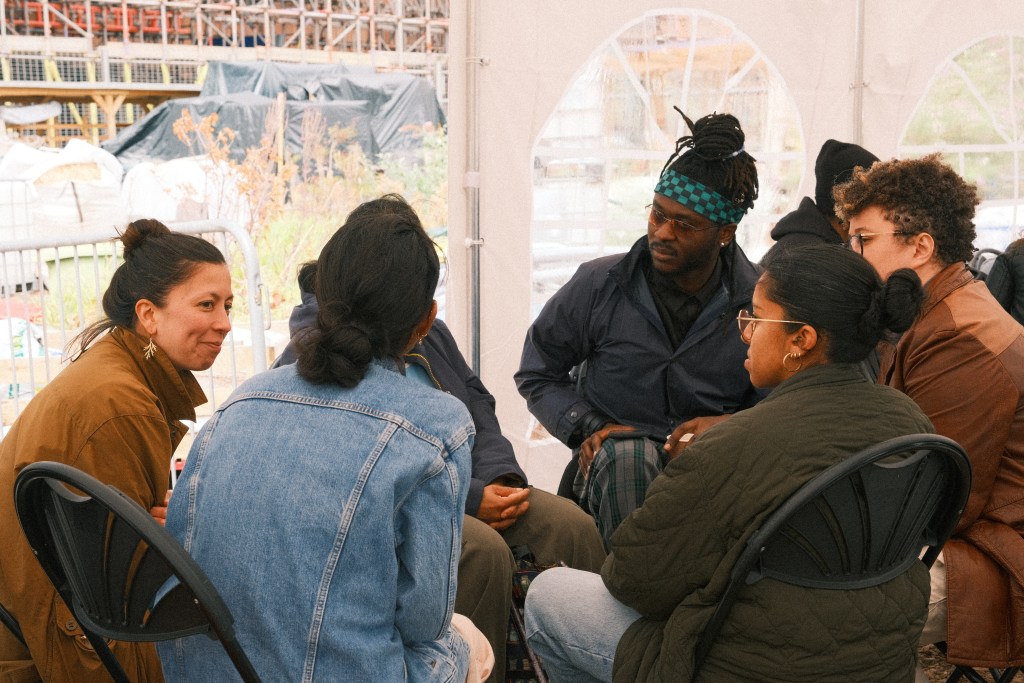
During our breakout discussions, we touched on everything from the challenges of using digital tools that may not align with movement values, to the importance of financial independence, and the need for in-person meetings to build relationships.
We talked about brilliant ideas that already exist, like libraries, that are slowly being removed from us. We shared ideas for future infrastructures, including democratic access to information, state-subsidised restaurants, and secure digital archives for preserving movement knowledge.
**
The rain stood no chance against the Solidarity Economy Showcase. I came away from the day with an abundance of gratitude, new connections, and a renewed sense of purpose in my own work towards building nourishing economic realities.
Reflecting on the event’s success, Guppi closed by saying: “What we’ve seen today is not just a celebration, but a reaffirmation of our collective power. The next five years will be crucial in scaling up our efforts and making the solidarity economy a tangible reality for more communities across the UK.”
When I look toward the future, the event outlined some key areas of collective focus: establishing a network of community-owned spaces across the country; developing a solidarity economy curriculum for schools and community groups; continuing creating mutual aid funds that support communities right now; and working to influence local and national policies on community ownership.
As one participant noted, “We’re building something beautiful, but we’re doing it within a system that often works against us. Our task now is to expand our reach while staying true to our principles.”
Nkenna is an Igbo writer and performer from London. She has an MFA in Playwriting from Brown University and is currently developing new work for theatre, film and TV. An ex-Director at Skin Deep, she dips back into editorial writing from time to time.
Want to learn more about the Solidarity Economy Showcase?
- Read volunteer and researcher, Stephanie Guzmán’s, reflections on the Nourishing Economics Showcase.
- Meet the Nourishing Economics’ ecosystem.
With love + care ...
We are now closed as a formal organisation but our work lives on to be built upon.
If you’d like to get in touch with the team, email us at info@decolonisingecomincs.org