

On a day that started with a bitter wind and cold rain, but ended in a joyful group rendition of Never Too Much by Luther Vandross, a determined group gathered to explore and share in the question: what does it look like when economics means caring for one another?
I attended the Solidarity Economy Showcase as a volunteer and a researcher, complementary roles that allowed me to fuse the learning opportunity with the excitement of participation.
I’m still a newcomer to this country, having only been in London for less than a year, so I genuinely treasure chances to join in and feel like a part of local action.
When I moved here to study for a master’s in Sustainable Resources: Economics, Policy and Transitions at UCL, my interest was in community practices of the circular economy. I initially imagined this simply as borrowing a cup of sugar from your neighbour. Small daily disruptions that led to patterns of waste and consumption avoidance.
While those activities do happen and have merit, what I’ve found in research and reflected powerfully in the Solidarity Economics Showcase was a much more expansive definition of non-capitalist practice. “Revolution” – one attendee’s description of his purpose in attending that day.
The event was much more than a showcase. It was an invitation for radical community-building, facilitated by the setting, lovingly cooked food, and openness from all those present.
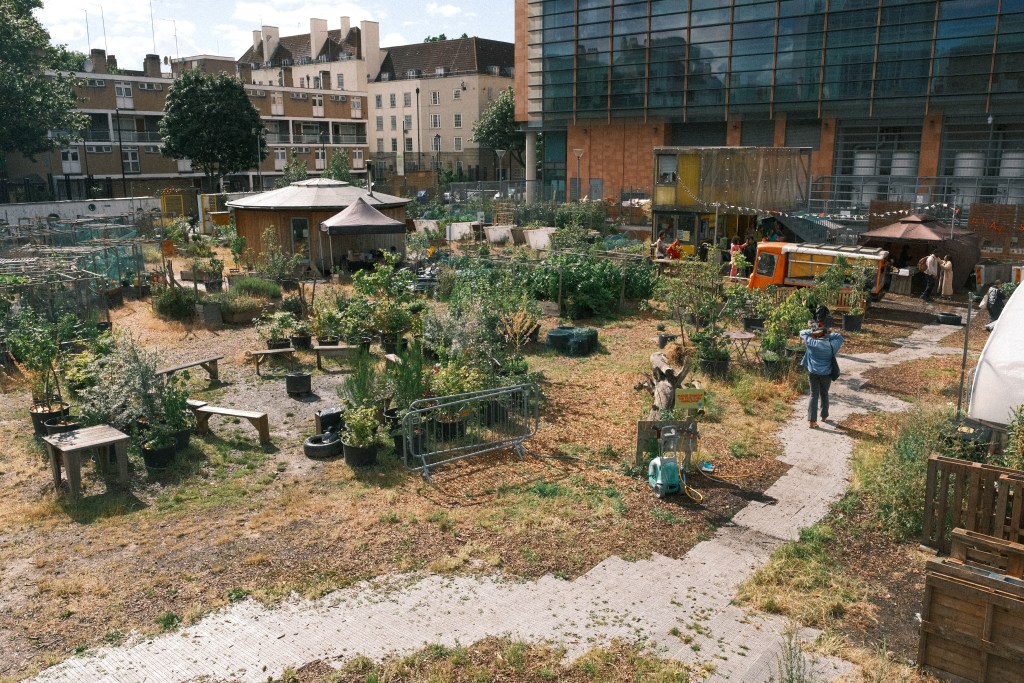
Global Generation’s Story Garden site is minutes from St. Pancras station, providing a natural, handwrought environment featuring yurts and wooden structures juxtaposed among looming, official-looking buildings.
I (naively) expected the focus to be on London, but as many speakers wheeled in with suitcases, you could tell immediately how much is shared among cities and contexts. There wasn’t a barrier between London and the rest of the UK for building solidarity.
As part of the check-in process, participants each got a hand-cut, colour-coded ribbon. Many had multiple roles within Nourishing Economics or from their own projects. smattering of colours could often be found pinned to someone’s shirt. This visual sums up the description from another attendee, “Spaces like this are where we can cross-pollinate.”
Diversity was celebrated in many forms – this was fundamentally an event by BPOC for BPOC, but anyone within solidarity economics circles was welcomed.
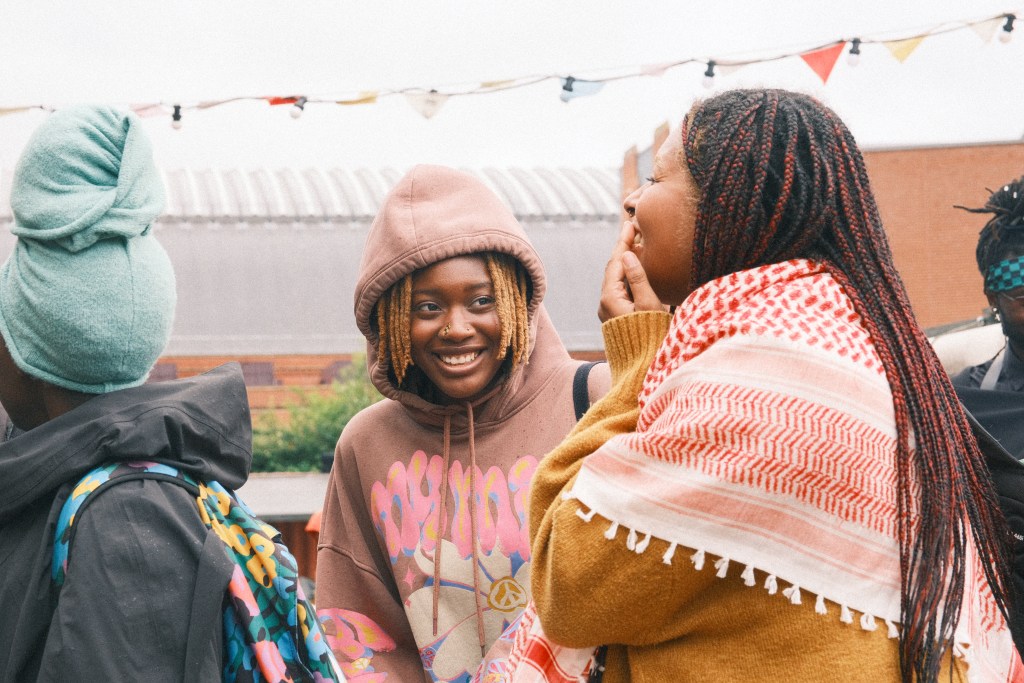
One of the many images that stood out to me was seeing keffiyehs of all colours – from traditional black-and-white patterns to hot pink – gathered under a tent listening to a Community Resistance for Self-Determination panel. I took the variety of the wearers to demonstrate the multitudes of approaches to the movement. The panellists spoke of their resistance across several mediums, ranging from active disruption to organising to writing, covering racialised capitalism and its manifestations from Gaza to South London in manufacturing weapons and police surveillance.
Another powerfully diverse combination of perspectives was shared during the session on Community Ownership and Self-Governance. This panel paired Black and Indigenous space reclamation movement leaders, ranging in age from children of the Windrush generation to those having young children themselves.
Each speaker shared how colonialism individualised notions of land ownership. One example noted by Claude Hendrickson, a Leeds-based champion of housing and wealth redistribution, was particularly resonant for me: former slaves in the southern United States collectivising land during Reconstruction, a period after slavery officially ended from 1865 to 1877. When successful, this allowed Black Americans to go from smallholders to partners in what would be known today as a community land trust.

My mother’s family has roots in South Carolina, a state undergirding the US’s agricultural riches, and I’m a descendant of both of the indigenous Gullah Geechee people as well as their enslavers.
Alongside the diversity in thought and experience was a necessary accommodation for physical accessibility that made the event better for everyone. Conditions were difficult as the wind and rain threatened the day and made the ground slick with mud, but there were warm options for respite throughout the site.
Talks throughout always employed a sign language interpreter or live captions alongside microphones wherever possible.
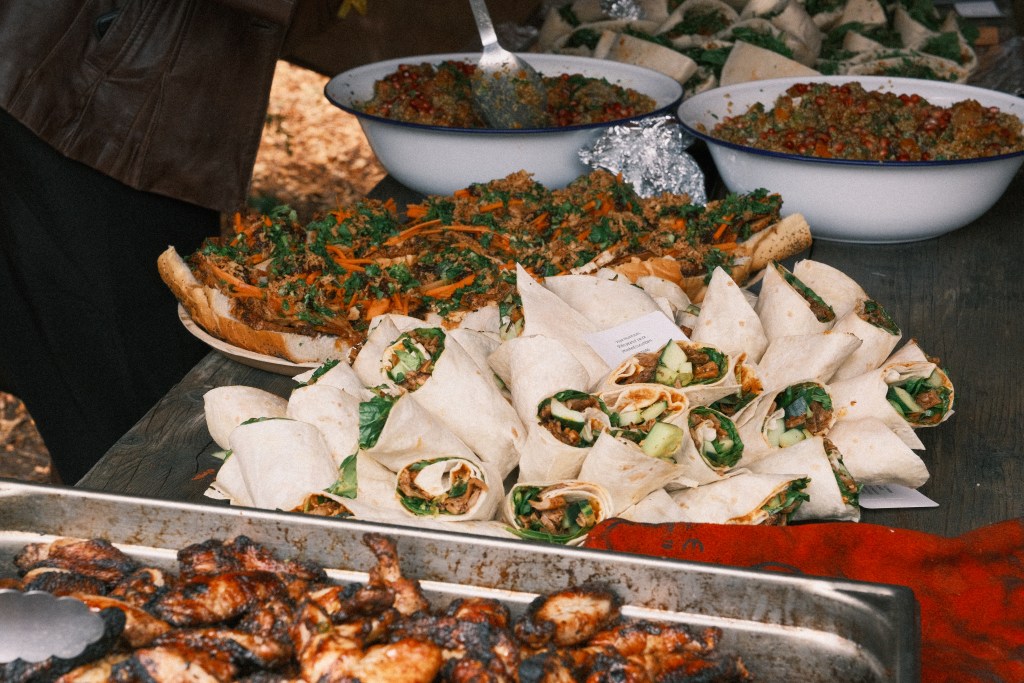
And, I’d be amiss not to mention the food. A wonderful array of options, it was plentiful and delicious (I’m still thinking about those chicken wings!), and it tangibly underscored the environment of care. Few things can bring people together like a shared meal.
Which brings me to the idea of nourishment.
In the first plenary, Introduction to the Solidarity Economy, organisers and co-founders Nonhlanhla Makuyana and Guppi Bola described how the aim of Decolonising Economics is to create “nourishing realities based on those economic futures.” Each session offered new insights into how this is being practised and what it means.
Javie Huxley of the Save Latin Village Campaign shared how Latin American communities in Elephant and Castle in London had been “self-sustaining and thriving” within a hyper-local economy for decades, despite a lack of official statistics on how many Latin Americans were even in the UK. This kind of major oversight could explain how developers ended up winning the bid for the Latin Village site in the name of ‘revitalisation’, and hearing about losing a community anchor like this also hit home for me as I’m Guatemalan on my father’s side.
A live podcast recording of a conversation with Stephanie Brobbey gelled around mental health, sharing journeys and methods of self-care. She spoke about how resistance takes a toll on the body, and finding the kind of work that fuels you against the pain that is often present in philanthropic spaces.
I also attended a workshop on Movement and Infrastructure, led by Mumbi Nkonde and Debs Durojaiye. My group’s conversation quickly turned to practices of collective memory and archiving, and how the internet can both facilitate and hinder these.

To me, the day’s collections of experiences underscored how the future of economics is already happening – often in ways overlooked by the mainstream but shared in interconnected layers of struggle.
Around 3:30pm, I wrote down in my notes: idea hour. By this point, I was feeling energised, my gears were turning. I got the chance to debrief with others from the workshop, including Josh, who works in community wealth building, and Debs, who shared an admiration for community tech projects in Detroit – something I got a glimpse of during a year living there. She and I also shared professional experiences from working in tech as designers.
I mention this point in the day and these conversations, because this is where I noticed the biggest shift in myself. My experiences from growing up and living in the US were not simply analogous to, they were part of the conversations happening right now in London.

In an earlier session, Guppi had explained how the day’s events were structured to mirror the path through the just transition, going from an extractive to a regenerative economy.
My own understanding built throughout the day such that I went from sponge-like learning mode to generating ideas, picturing how I could give back knowledge from my postgrad research into ways communities share and exchange materials, while elevating existing practices.
The learning, inspiration, and restoration I got to experience with the Solidarity Economy Showcase felt like my own corner of this interconnected, life-giving force.
Author Mikaela Loach spoke of a brilliant metaphor for movement-building, comparing it to large mushrooms like chicken of the woods growing in the forest. If you see them in the wild, their size might seem like a miracle. In reality, they are the accumulation of networks feeding off of both death and life underground, sharing resources and growing in ways dependent on the health of the overall forest.
As I reflected about the event with Samia Dumbuya, a friend, classmate, and one of the day’s presenters, noted, “It felt whole.” I couldn’t agree more.
Stephanie Guzmán is a Washington, DC-raised dual American and Guatemalan citizen who is finishing her master’s at University College London in Sustainable Resources: Economics, Policy, and Transitions.
When not researching or writing about sustainability, she can be found playing football (soccer) and visiting as many libraries as possible. She’s currently searching for new opportunities – head here to collaborate or find out more about her previous product design work.
With love + care ...
We are now closed as a formal organisation but our work lives on to be built upon.
If you’d like to get in touch with the team, email us at info@decolonisingecomincs.org